My Role & Objectives
I joined Grubhub as a Sr. Manager overseeing design for Care, Post Purchase Experience and Fulfillment, and now lead design for all B2B2C experiences — the 3-sided campus marketplace, corporate partnerships, the corporate B2C diner experience, merchant tooling and merchant marketing. My goals are:
- Build organic relationships between Product and Design
- Introduce frameworks to help designers think strategically about business goals
- Coach and empower the design team on how to merge business and user goals and communicate Design business value
- Advocate early and often for Design thinking
- Scale processes across GH to build strategic Design influence and partnerships
The OBD Framework
I introduced the Outcome-Based-Design framework as a method to help merge the gaps between Product and Design languages and introduce design-thinking methods upstream in the product development process.
The framework "starts at the end" by enabling designers to work with product managers to define "outcomes" or business goals that a project — or series of projects — will achieve after launch.
The framework ensures that designers working through design thinking exercises consistently check their work against previously aligned-on business goals and make sure their designs drive those goals forward.
OBD & Increased Reorders
One of the areas my Care Design team successfully implemented the Outcome Based Design framework was in trying to solve our merchant-led cancellation problem.
Outcome
Increase same-day reorder rate among diners who experience a merchant-led cancellation — 3% of Grubhub cancelled orders. These diners have a historically lower reorder rate than other diners.
Phases
1Design/Product/Business align on business outcomes
2Design conducts user research to identify core user needs and problem origin
3Team aligns on MVP and North Star opportunities
4MVP is scoped for upcoming quarter, to then be iterated on as a fast follow
5Design creates visual concepts to test theories of most likely opportunities against expected business outcomes
6Design leads ideation session for Design/Product/BI/Eng to align on the opportunities that are most feasible and drive the business outcomes forward
Example: Final Designs
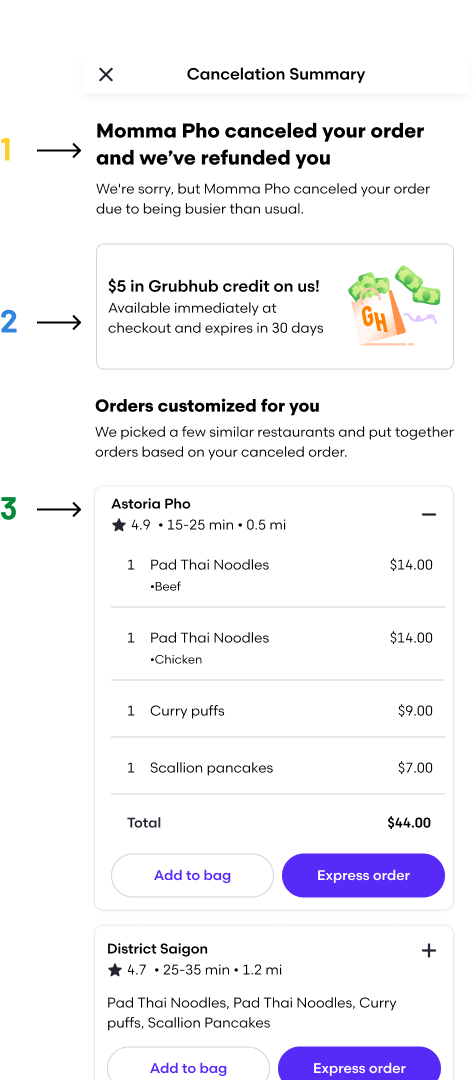
The final design concept was a 3-part solution to drive the business outcomes the team had aligned on:
1More transparent messaging to give the user context around why their order was cancelled
2An automatic, good-faith concession for users to apply towards another order
3Clear next steps — in the form of AI-driven, pre-built carts similar in nature to the original order placed. This removes the "cold start" experience from the reorder process and takes the onus off the user of finding another solution for dinner.
Scaling OBD
The OBD framework is now scaled across the design orgs at Grubhub as a tool to help designers engage with their cross-functional teams as business partners as well as user advocates.
Logistics Design Team
Used the OBD framework to help define the 2025 roadmap for our "Driver Engagement" workstream.
Merchant Design Team
Currently using the OBD framework to align on a north star vision for our merchant-facing promotions tool, a key differentiator for GH's merchant partnerships.